ignore
Use the ignore command to add findings or vulnerability IDs to the ignore file, which is used to dismiss findings during scans. This allows developers to request exceptions directly in their pull requests and provides teams with the option to manage exceptions directly in the source code.
Usage
The syntax of the endorctl ignore command is:
endorctl ignore [--finding-uuid <uuid> | --vuln-id <vuln-id>] [-i] [flags]
You must provide --finding-uuid, --vuln-id, or --interactive. If you provide a
finding UUID, you must also provide --namespace.
The more fields you provide, the more specific the ignore entry is. For example, if you only provide the finding name and there are multiple findings with the same name in the same repository version, the ignore entry is applied to all of them.
Options
The command endorctl ignore uses the following flags and environment variables:
| Flag | Environment Variable | Type | Description |
|---|---|---|---|
comments |
ENDOR_IGNORE_COMMENTS |
string | Optional comments to add to the ignore entry. |
expiration-date |
ENDOR_IGNORE_EXPIRATION_DATE |
string | Stop ignoring the finding on this date (format: YYYY-MM-DD). |
expire-if-fix-available |
ENDOR_IGNORE_EXPIRE_IF_FIX_AVAILABLE |
boolean | Stop ignoring the finding if a fix becomes available. |
finding-uuid |
ENDOR_IGNORE_FINDING_UUID |
comma-separated string | UUID of finding to ignore. |
interactive |
ENDOR_IGNORE_INTERACTIVE |
boolean | Enter finding and/or ignore entry details interactively. |
path |
ENDOR_IGNORE_PATH |
string | Path to the repository or file to add the ignore entry to (default .endorignore.yaml). |
prefix |
ENDOR_IGNORE_PREFIX |
string | Override the default prefix for the ignore entry ID (default endorignore-, or project name if added by finding UUID). |
reason |
ENDOR_IGNORE_REASON |
string | Reason for ignoring the finding. Valid values: false-positive, risk-accepted, in-triage, resolved, other (default risk-accepted). |
username |
ENDOR_IGNORE_USERNAME |
string | Override the username associated with the ignore entry. |
vuln-id |
ENDOR_IGNORE_VULN_ID |
comma-separated string | Vulnerability ID to ignore, such as CVE or GHSA identifiers. |
Examples
Ignore a finding based on UUID
Ignore a specific finding based on the UUID and enter details such as reason and expiration-date interactively:
endorctl ignore --finding-uuid $FINDING_UUID --namespace $NAMESPACE -i
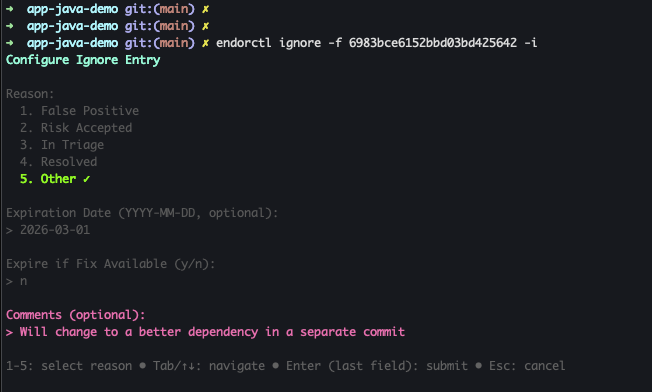
Ignore entry based on finding UUID and interactive input
Here the user entered the reason, expiration date, and comments interactively. The rest was automatically populated based on the finding UUID. The default prefix is the finding project name.
 version: 1.0.0
 ignore:
   - id: endorlabs/app-java-demo-1
     username: bob@corp.com@google
     update_time: 2026-02-09 22:35:04 UTC
     finding_name: Unmaintained Dependency org.webjars.bowergithub.webcomponents:shadycss@1.9.1
     parent_name: mvn://com.endor.webapp:endor-java-webapp-demo@4.0-SNAPSHOT
     dependency_name: mvn://org.webjars.bowergithub.webcomponents:shadycss@1.9.1
     extra_key: mvn://org.webjars.bowergithub.webcomponents:shadycss@1.9.1
     reason: other
     expiration_date: 2026-03-01
     comments: Will change to a better dependency in a separate commit
Enter all details interactively
Enter all details about which findings to ignore interactively, without the UUID:
endorctl ignore -i
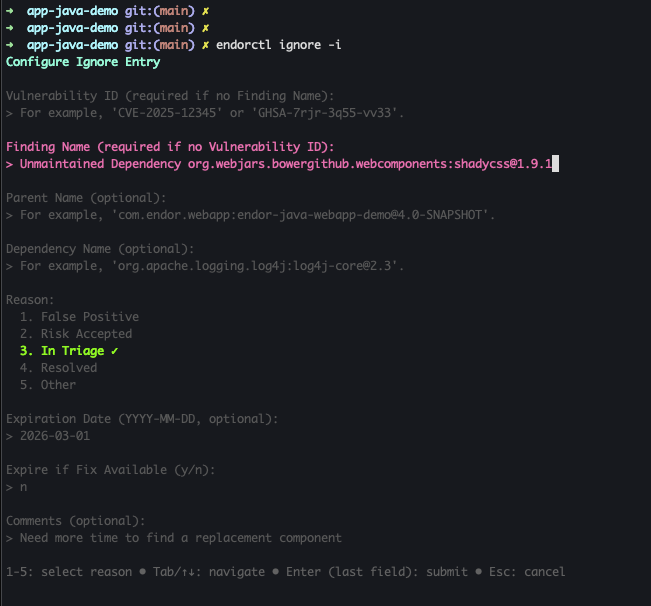
Ignore entry based on interactive input only
Here the user entered the finding name, reason, expiration date, and comments interactively. The default prefix is endorignore-.
 version: 1.0.0
 ignore:
   - id: endorignore-1
     username: bob@corp.com@google
     update_time: 2026-02-09 22:36:01 UTC
     finding_name: Unmaintained Dependency org.webjars.bowergithub.webcomponents:shadycss@1.9.1
     reason: other
     expiration_date: 2026-03-01
     comments: Will change to a better dependency in a separate commit
Automation
Use command in a script to ignore findings based on UUID with a custom prefix:
endorctl ignore \
  --path=$PATH_TO_IGNORE_FILE \
  --prefix=$CUSTOM_PREFIX \
  --namespace=$NAMESPACE \
  --finding-uuid=$FINDING_UUID \
  --username=$USERNAME \
  --reason=$REASON \
  --comments=$COMMENTS \
  --expiration-date=$EXPIRATON_DATE \
  --expire-if-fix-available=$EXPIRE_IF_FIX_AVAILABLE
Feedback
Was this page helpful?
Thanks for the feedback. Write to us at support@endor.ai to tell us more.
Thanks for the feedback. Write to us at support@endor.ai to tell us more.